By Yui Kajita, Munich, Germany
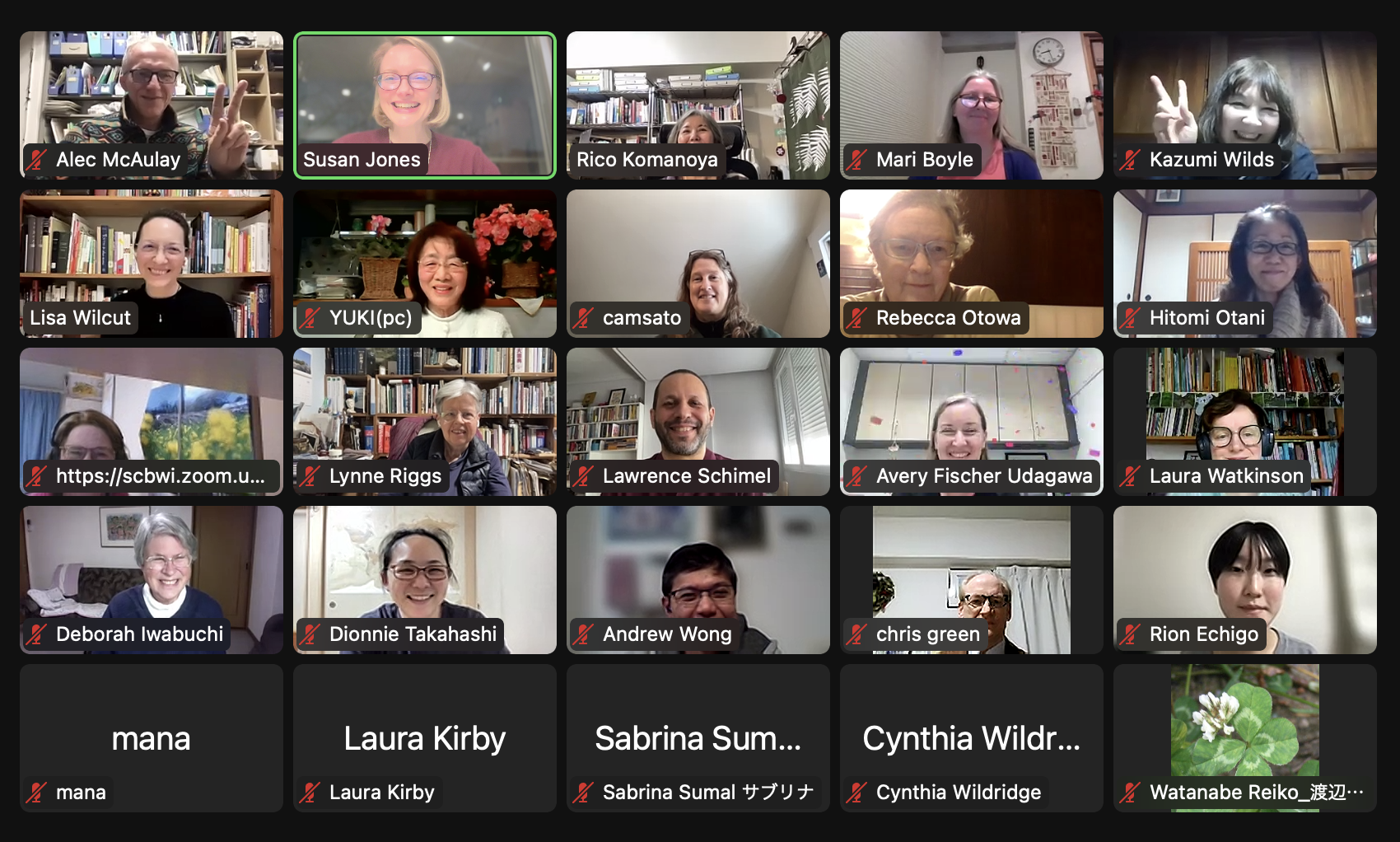
The biennial SCBWI Japan Translation Day(s) returned for its seventh run in November 2022 with another exciting line-up. As with the last event in 2020, it took place over Zoom, allowing speakers and participants to gather from different countries all over the world, including Australia, Canada, Italy, Japan, New Zealand, Thailand, the UK, and the US. Always highly anticipated by both familiar faces and newcomers, this year’s program was once again full of useful information, inspiring anecdotes, and translation conundrums that everyone loves to mull over.
A Conversation with Editor Kathleen Merz, interviewed by Deborah Iwabuchi
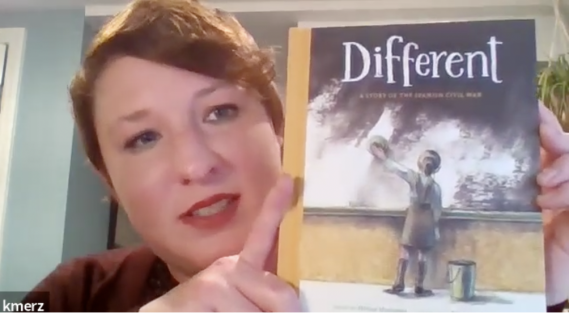
Editorial Director Kathleen Merz
Kicking off Day One (November 12, 2022) was a live interview with Kathleen Merz, Editorial Director at Eerdmans Books for Young Readers, led by Deborah Iwabuchi. We heard about how Eerdmans came to focus on children’s books in translation: Garmann’s Summer (by Stian Hole, translated by Don Bartlett), which won the Batchelder Award, was an important starting point, and now at least half of the titles they publish each year are translations. Historically, they’ve found many European titles through the Bologna Children’s Book Fair, but they are eager to branch out to Latin American, Asian, and African publishers as well to expand the range of their list.
While Eerdmans originally specialized in theological textbooks (their history goes back to 1911), Kathleen is interested in a broad range of books, both fiction and non-fiction, picture books and middle grade. She loves to find books that are great conversation starters, introducing kids to things they might not be familiar with. For example, some favorites that she recently edited include a beautifully illustrated book about the Spanish Civil War, called Different (written by Mónica Montañés, illustrated by Eva Sánchez Gómez, translated by Lawrence Schimel) and a picture book introduction to paleontology, One Million Oysters on Top of the Mountain (written by Alex Nogués, illustrated by Miren Asiain Lora, translated by Lawrence Schimel), which is finding its way into school curricula. Kathleen values storytelling most of all, where different cultures, traditions, and so on are lived out as part of the narrative rather than shoehorned into the moral of the story.
It was interesting to hear about the part translators can play even in a book’s format: at Lawrence Schimel’s suggestion, Eerdmans took the text-dense picture book, Different, and transformed it into an illustrated middle-grade novel, which made it more accessible for the right US readership.
Though Kathleen often finds new translators through networks, she also shared useful tips on what she’d like to see in a pitch. Participating in this kind of SCBWI event is certainly another way for emerging translators to get their foot in the door.
Jocelyne Allen on Translating Colorful by Eto Mori, introduced by Holly Thompson
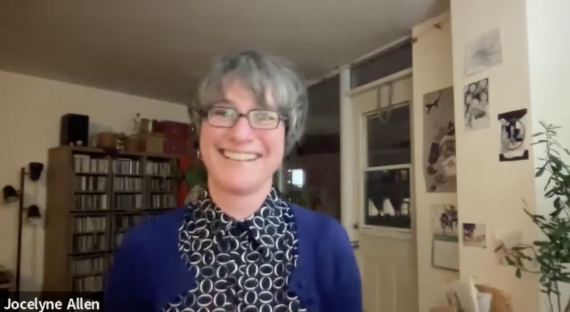
Translator Jocelyne Allen
After the “speed share” session, where the group got to hear from each participant about their current project, Jocelyne Allen gave a dynamic talk on how she came to translate the beloved classic Colorful (Counterpoint Press, 2021) by Eto Mori and the process of working closely with the editor, Yukiko Tominaga, to shape the voice of the novel.
Jocelyne was approached by Counterpoint Press to translate the book—she had been recommended to them by the foreign licensing team at Bungeishunju, whom she had known for years, and it also helped that the editor at Counterpoint had read Jocelyne’s translation of A Small Charred Face by Kazuki Sakuraba before. Jocelyne said it was a joy to work with Counterpoint, from the sample translation and grant application stage all the way to book production, as they truly respected her work as a translator.
Diving into the nitty-gritty details of the translation process of Eto Mori’s deceptively simple prose, Jocelyne offered so many juicy examples of what thoughts went into certain stylistic choices and how she dealt with particularly tricky issues, ranging from questions of tone and register to recurring keywords, and how to localize the text with minimal glossing. For example, she found a way to channel the character Hiroka’s childish, coquettish way of talking in English by using babyish words (like “horsey” for horse), peppering her dialogue with “like” and “so” (as in “so pretty”), and opting for more descriptive dialogue markers (“squeal” or “coo” instead of just “said”). She also shared how she arrived at a translation of the word 再挑戦 (rematch? re-try? do-over? second chance?) that would actually sound like a 14-year-old boy while also fulfilling its role as a keyword for the theme of the novel.
It was engrossing to hear how she brought the text to life in English, and how she worked together with her editor to make it happen.
You can find out more about Colorful and Jocelyne’s translation in this in-depth interview by Holly Thompson.
Presentation and Discussion of Japan Foundation Grant Funding by Aya Tamura from The Japan Foundation
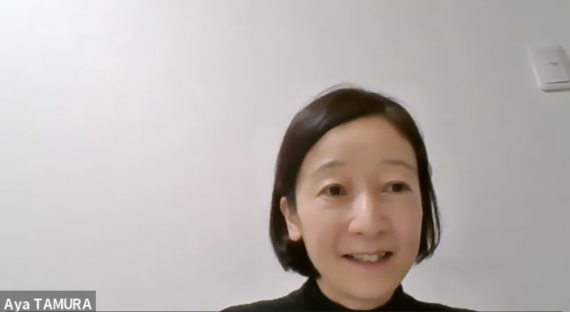
Aya Tamura from The Japan Foundation
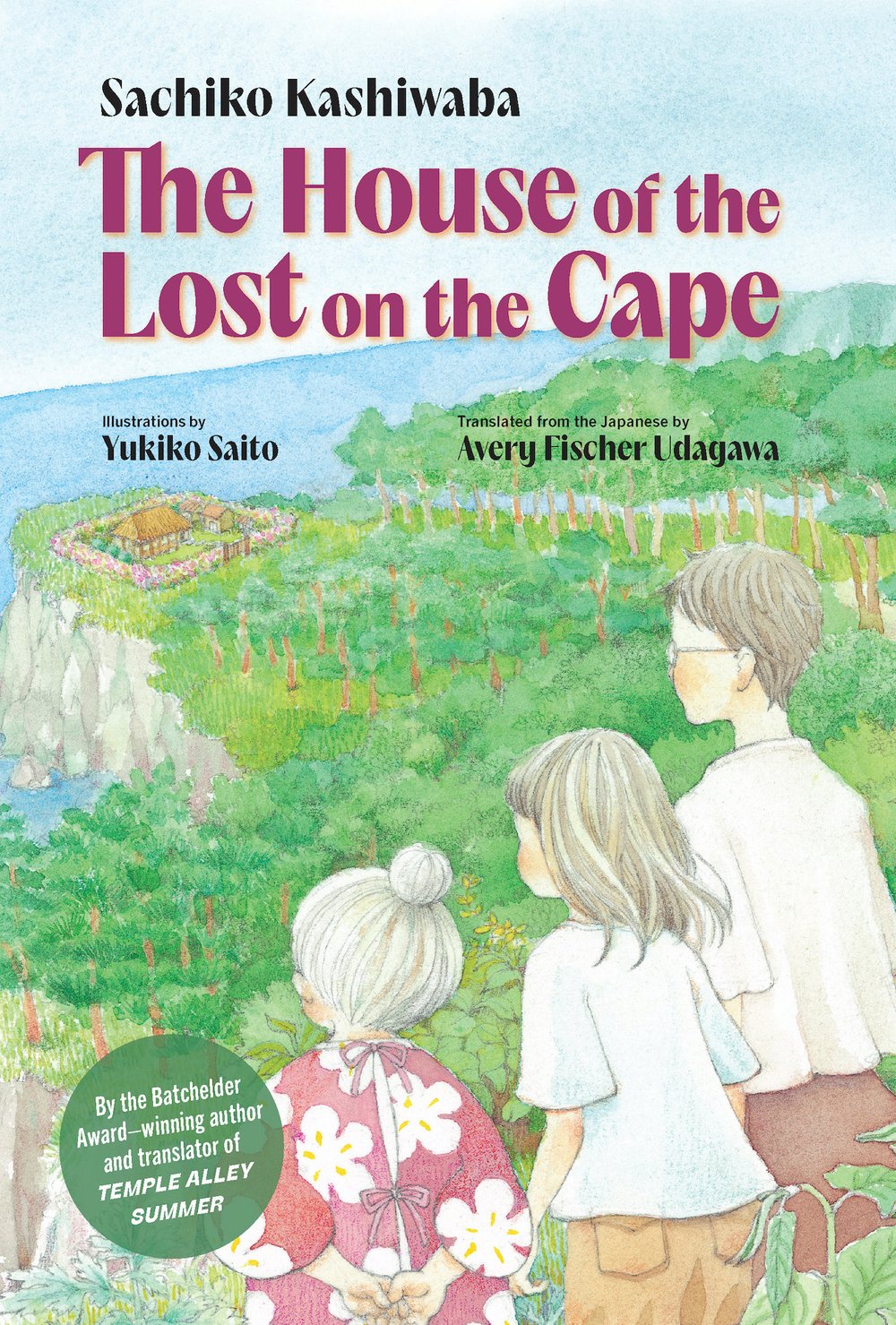
One funding scheme that supported both Jocelyne’s translation of Colorful and Avery Fischer Udagawa’s translation of Temple Alley Summer by Sachiko Kashiwaba was the Japan Foundation’s Support Program for Translation and Publication.
 Aya Tamura, who works in the Arts and Culture Department’s Planning and Coordination / Literary Arts Section at the Japan Foundation, gave a thorough presentation on the Japan Foundation’s wide-ranging initiatives, especially the evolution and the reach of their translation support program. To date, they have supported the publication of nearly 1,500 books in 75 countries or regions, translated into 52 different languages. Excitingly for the kidlit community, they have recently launched Lifelong Favorites, a selection of children’s books that are or are expected to become classics that many children grow up with in Japan, which will be given priority in their support program selection. Though they had always been open to awarding grants for children’s literature, now, with this list, they hope to encourage more applications from children’s publishers.
While the grant application must be submitted by publishers, not individual translators, the Japan Foundation is enthusiastic about supporting the work of translators, and Aya invited ideas from the participants as well. The Japan Foundation’s recent projects include the Translator’s Roundtable Series (More than Worth Sharing, which garnered much attention from the translator community), the Translator Spotlight video interview series, and the Writing to Meet You series (an exchange of letters between authors). Her presentation offered information on other governmental support programs as well, including Japan Book Bank, an online catalogue of rights to Japanese content. Translators can look forward to more support initiatives from the Japan Foundation in the future!
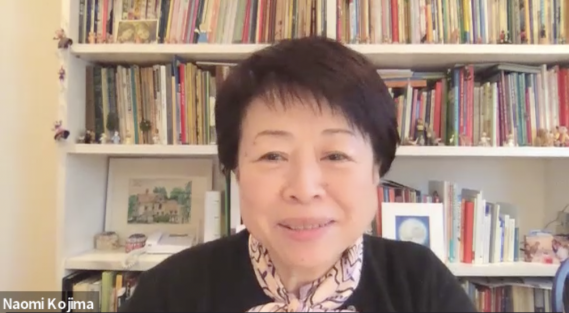
Illustrator Naomi Kojima
We were also treated to an insider’s look at Naomi Kojima’s process of creating the banner and logo for Lifelong Favorites. She walked us through how she developed the illustration concept, starting from the idea of flying books, gradually evolving into the joy of welcoming and meeting a good book. Her brainstorming sketches were delightful to see.
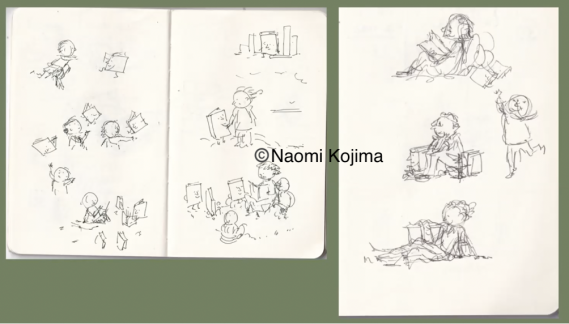
A few examples of Naomi Kojima’s sketches for Lifelong Favorites
A Conversation with Editor Marilyn Brigham, interviewed by Andrew Wong
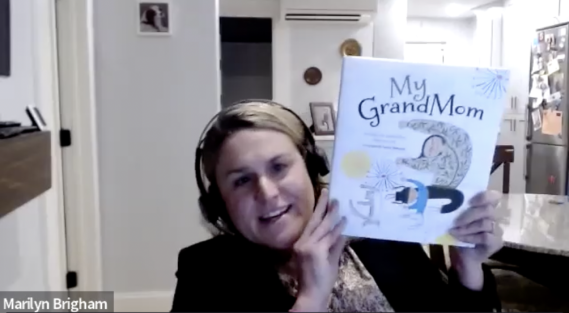
Senior Editor Marilyn Brigham
Day Two (November 19, 2022) began with an interview with Marilyn Brigham, led by Andrew Wong. Marilyn is Senior Editor at Two Lions and Amazon Crossing Kids, the two children’s book imprints at Amazon Publishing, and she shared how the imprints and she herself came to be involved in translated children’s books, the imprints’ commitment to regional diversity, and what they look for in kidlit in translation.
Observing the big push in recent years for diverse children’s literature as a way of getting fresh voices and perspectives, Marilyn is hopeful that an increasing openness to translations will continue in the future. Amazon Crossing’s list has a good mix of commercial and literary titles, and the books she has worked on have won both critical and popular acclaim, including multiple USBBY Outstanding International Book awards and a Goodreads Choice Award finalist for Best Picture Book. She is also eager to expand their middle-grade list, especially story-driven books with a commercial plot: she is currently working on a mythological fantasy story from Kazakhstan and a historical crime-mystery series from Sweden. Her enthusiasm was infectious as she introduced two brand new books, My GrandMom (by Gee-eun Lee, translated by Sophie Bowman) and Piece by Piece (by David Aguilar and Ferran Aguilar, translated by Lawrence Schimel).
She is always on the look-out for books, and there are many ways in which she meets new translators: through networks, recommendations from publishers, or books that come with the translator attached.
In her editorial choices, she prefers to retain the source culture as much as possible—sometimes adding a little glossary, or a publisher’s note, depending on the project—because she likes the books to have a sense of place. “Books can show all the ways we’re different, and all the ways we’re the same, and that’s the beauty of it.”
Takami Nieda on Translating The Color of the Sky is the Shape of the Heart by Chesil, introduced by Alec McAulay
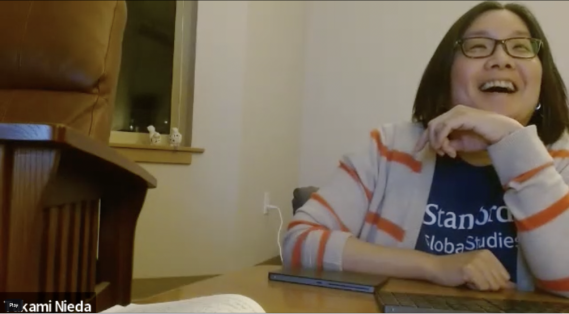
Translator Takami Nieda
Takami Nieda gave a fascinating talk on her experience of translating The Color of the Sky is the Shape of the Heart (Soho Teen) by Chesil. We heard the surprising story of how this book came to be in the first place—Chesil was initially pursuing a career in acting, but she challenged herself to write a novel to mark the end of her twenties, and this very first book she wrote was shortlisted for the Akutagawa Prize. The protagonist, a zainichi teen straddling different cultures, is also a blossoming writer, and it is a story of how she reclaims or makes sense of her past and of herself through writing.
Because of her own background as an Asian American, the novel’s themes of “in-between-ness” resonated with Takami. As with Kazuki Kaneshiro’s Go, another book she translated, Chesil’s work struck her as the kind of story she wished she had had access to as she was growing up in the US. At the same time, it’s a “teachable story,” which she is always looking out for as a community college teacher.
Takami’s talk explored various questions, such as how much cultural bridging we should do in children’s books. She resists that idea and usually tries to do as little of it as possible, unless it’s absolutely essential for the story, so that readers can encounter stories that don’t center around their own culture or experience—after all, it’s only natural for readers to come across things they don’t understand.
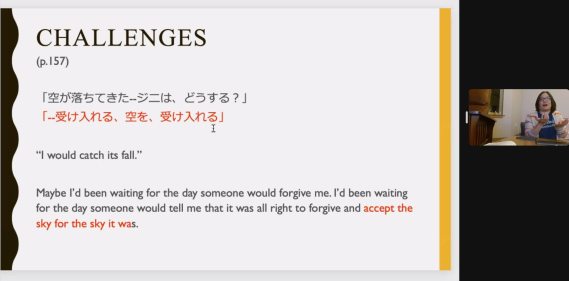
Takami Nieda discusses translating a key phrase in The Color of the Sky is the Shape of the Heart.
There’s often talk about “what’s lost in translation,” but it was great to hear examples of what’s gained instead. For instance, the English novel could play up the theme of crossing cultural identities by varying the spelling of the protagonist’s name depending on where she was: Ginny Park in Oregon and Pak Jinhee in Japan. Also, since English can’t skip over pronouns as much as Japanese does, the star that Ginny has a conversation with was written with she/her, enhancing the sense of sisterhood between them. Chesil was very accommodating when discussing all these questions, as she came to the project with the understanding that a translation of her novel would be another being on its own.
You can read more about the book and Takami’s translation in this interview by Susan Jones.
After her talk, Takami valiantly led a translation workshop, critiquing the participants’ translations of an excerpt from Natsuki Koyata’s 『望むのは』, a book about difference and accepting difference—where your classmate’s mother can be a gorilla, and your friend can have a crush on an ostrich—which won the Sense of Gender Award in 2017. The group had a lot of fun picking apart questions of word-choice, sentence structures, condensation and embellishment, and so on, including how that slippery wasei-eigo イメージ (a katakana version of “image,” widely used for an impression, a look, how one perceives someone, how one visualizes an action or idea, etc.) can be handled as its meaning shifts throughout the passage.
You can read seven translations of the passage, including Takami’s, here.
Overall, Translation Days 2022 was a stimulating event, giving us renewed energy to carry on with our current projects and discover new ones. These inspiring conversations and a generous session on submission opportunities(for participants only), with practical tips on how to find leads and build connections, are sure to keep the fire going!
All credit goes to the lead organizer, Avery Fischer Udagawa, and the SCBWI Japan regional team, Mariko Nagai, Mari Boyle, Alec McAulay, and Naomi Kojima, for their enthusiasm for all things world kid lit and their dedication to putting together a wonderful program for the community.




 SCBWI Japan Translation Group